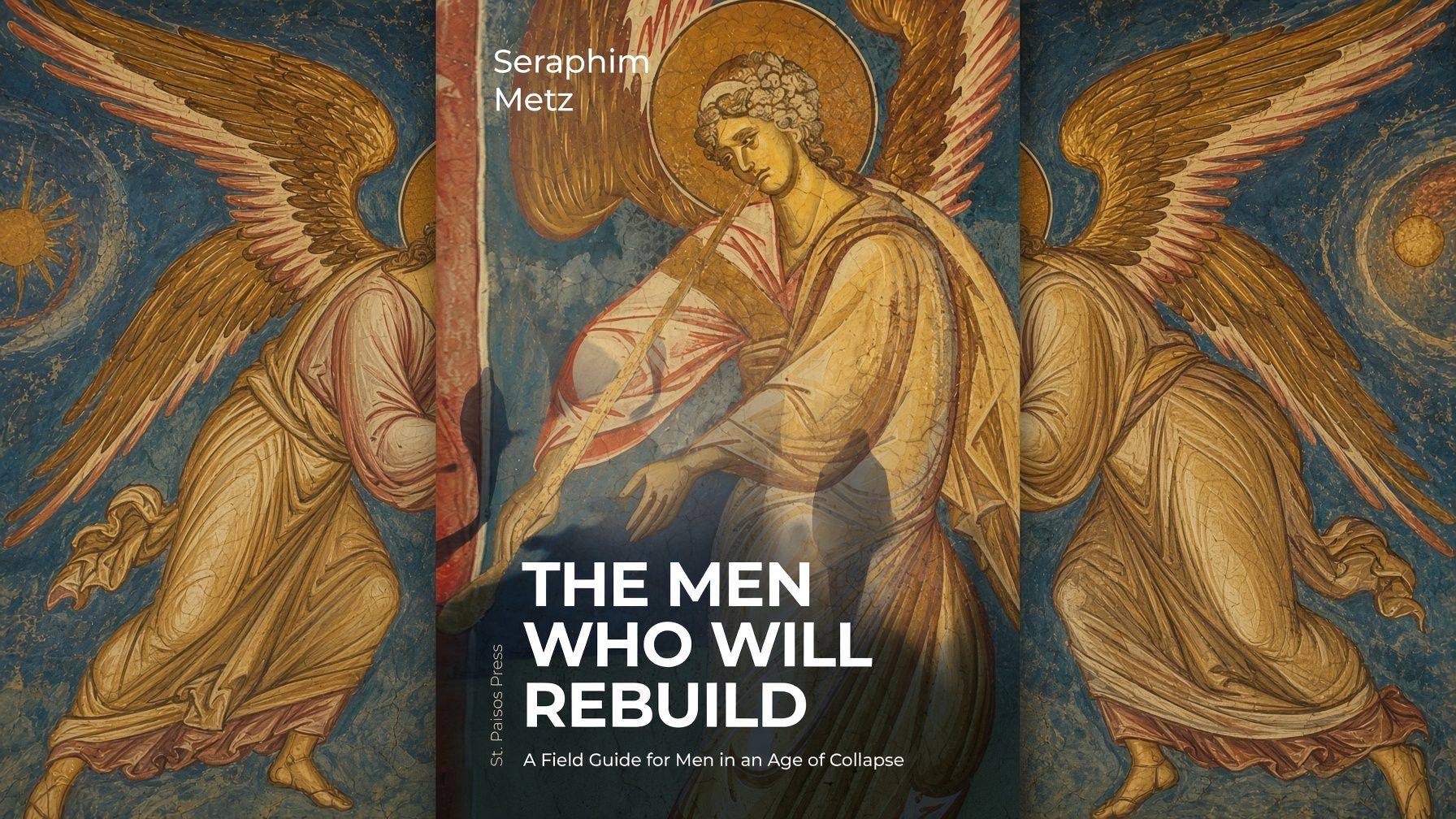
Three movements, in order: gathered, aimed, offered. This chapter is the first of them, and it cannot be skipped, because a gathered man must come before an aimed man.
Most men who keep breaking faith with themselves have been handed one prescription: try harder. They summon their willpower, it does not hold, and they conclude that they are weak. The Church says something older and far more merciful. The Fathers call this condition the dipsychos: the double-souled man St. James calls “unstable in all his ways.” (Jas. 1:8) St. Maximus names its mechanism exactly: fallen man wills with a gnomic will, a will that does not simply see the good and choose it but hesitates, wavers, and is pulled among a dozen competing goods.1 He is not many men. He is one man whose powers no longer pull together.
So the cure is not force. Force only makes the halves fight harder. The cure is healing. The first work is to gather what is scattered.
This is the watchfulness that guards the mind. It is the cutting off of a thought before it takes root. It is the truth-telling that ends self-deception. It is the Mystery of Confession that heals the conscience. And above all, it is the Rule of Life, which gives a scattered man a single, faithful shape.
Purity here is less about the body than about singleness of heart: the heart that wills one thing.
Now recall what Maximus suffered for. They took his tongue and his right hand because he would not stop confessing that Christ has a real human will. That fight was never academic. If the Son did not take up a human will, then the human will, the exact thing that fails you every morning, was never carried into God, and never healed. What is not assumed is not healed. Maximus bled for your will.
And he pointed to the garden to show what a healed human will looks like. In Gethsemane, Christ’s human will faces the Cross and recoils, “let this cup pass from Me,” and then, without division, without the long interior committee meeting you and I know so well, gives itself whole: “nevertheless not My will, but Yours, be done.” (Lk. 22:42; Mt. 26:39) Maximus insists there is no wavering in that moment, no deliberating among options, no self negotiating with itself. There is a real human will, under real agony, freely and wholly aligned with the Father. That is not the destruction of your will. That is your will, home.2
So the goal of everything in this chapter is not a man with a stronger grip. It is a man whose willing is being simplified, gathered out of the committee and into a single yes. You will not finish that work in this life. But every time you catch the wavering and turn, you are being conformed to the will that prayed in the garden.
Most of this book does this gathering work, and it is indispensable. But it is not the whole of a man. A program that stops here produces a careful, well-defended, quiet man who has stopped sinning grossly and has not yet begun to live. That quiet is exactly what many men experience as the loss of themselves.
The daily questions are the simplest and most powerful tool for this gathering.
When a man is asked every morning whether he kept his commitments the day before, he is forced to tell the truth about where he actually is. When he is asked where he saw a thought and how soon he named it, he begins to notice the movements of his own heart earlier. Over time, this practice gathers what has been scattered. The man who once lived in a blur of reactions and justifications begins to live with greater clarity and honesty.
Watchfulness is the foundation.
The Fathers taught that the thought arriving is not yet sin. The first movement, what they called the prosvoli or assault, is not yet sin. Sin begins when we entertain the thought, when we consent to it, when we act on it.3 A watchful man learns to cut the thought off at the first movement. He does not argue with it. He does not entertain it. He names it and turns away.
One caution before you try this, because the men who are best at discipline get it wrong first.
Watchfulness is not vigilance you generate. Somewhere around the third week you will discover that you cannot see your own heart. You will catch the obvious thoughts and miss the ones that matter, and the ones that matter will be wearing the clothing of your virtues. The Fathers are blunt about it: the discernment of thoughts is a gift before it is a skill, given by the Holy Spirit to a man who asks for it, and given, ordinarily, through a confessor and a brother who can see what he cannot. The asking is where humility actually lives. Not in how a man speaks about himself, but in his conceding that he cannot see his own heart and then declining to pretend otherwise. This is why the watch and the daily call belong together, and why neither survives as a private technique. You are not developing a faculty. You are asking to be shown, and then checking what you were shown against men who love you.
The Fathers even mapped the road a thought travels, station by station. First comes the assault, when the thought simply arrives; no sin yet, and no shame in it. Then coupling, you turn it over, converse with it, pull out a chair for it. Then consent, the will says yes, even if the body has not yet moved. Then captivity, the thought now drags you where it wants to go. Last comes passion, the groove worn so deep that the dragging feels like your own nature. (St. John Climacus, Ladder, Step 15) Learn the stations, but hear this first: they are a map, not a ledger. The moment counting stations becomes a way of scoring yourself, put the map down and see your priest. Learn them so that when your brother asks where you caught the thought, you have an honest answer: “at coupling. I had already pulled out the chair.” The win is seeing the station. Catching it earlier will come on its own.
Alex was twenty-six when an older man from our circle drove him to his first Tuesday: working remotely, living alone, numbed by screens, and losing most nights to the same eleven o’clock visitor. He learned the stations before he learned to win. It began one night when the thought arrived at 10:52, eight minutes earlier than it had ever announced itself, and he said “There it is” out loud to an empty kitchen. He lost that night. But on the call the next morning he had a sentence he had never had before. “It came at 10:52. I sat with it until about 10:56. That’s coupling. I pulled out the chair.” His brother did not lecture him. He thanked him for telling it straight and asked what those four minutes had felt like. Naming the station is not a consolation prize for a man who fell. It is the first thing he has ever been able to hand another man about the inside of his own night.
This is freedom, not repression. The man who learns to cut off a thought before it takes root is no longer dragged wherever his thoughts lead him. He begins to choose.
The Fathers give this freedom a picture, and it is worth carrying with you.
When Peter stepped out of the boat, the storm did not stop for him. The waves were exactly as high after he stepped out as before. But while his eyes were on Christ, he walked on them. The moment his eyes dropped to the waves, he began to sink. Nothing in the storm had changed. Only his focus had.
This is watchfulness in a single image. The thoughts are the waves. You do not calm them by staring at them, arguing with them, or measuring how high they are. You calm nothing. You look at Christ, and you walk.
Elder Aimilianos of Simonopetra, one of the great Athonite fathers of the last century, made this image the heart of his teaching on watchfulness, and his spiritual children still teach it to ordinary working men today.4 The instruction could not be simpler: when the wave rises, do not study the wave. Say the Name. Look up. Keep walking.
A man who practices this discovers something strange. The waves do not need to disappear for him to stop drowning.
One practical rule will save you years of confusion: reject the judging thought in both directions.
You are walking down the street, or scrolling, or sitting in the parish hall, and a thought arrives about another man: how he dresses, how he talks, what he has, what he lacks. The thought may be contemptuous. It may be admiring. Cut it off either way.
This sounds severe until you see the trap. If the comparison finds him beneath you, it feeds your pride. If it finds him above you, it feeds your despair. There is no third outcome. You cannot win a game of comparison; you can only lose it slowly or lose it quickly.
So the watchful man does not sort his judging thoughts into fair and unfair, kind and unkind. He declines the game. He names the thought, “comparison,” and turns back to his own work and his own prayer.
When your brother asks where you saw a thought yesterday, this is one of the most common honest answers: “I spent ten minutes measuring myself against another man.” Naming it out loud is how the habit dies.
Truth-telling and Confession complete the gathering.
A man can cut off thoughts in private and still remain divided if he never brings what is hidden into the light. Confession is not primarily about clearing a record. It is about bringing the infected thing out into the open so that it loses its power. When a man names his real struggles to a priest and to his brothers, something in him that was hidden and festering begins to heal.
The Rule of Life holds all of this together.
Morning and evening prayer, the Jesus Prayer, Scripture reading, fasting, almsgiving, and daily accountability are not a list of religious duties. They are the ordinary structure through which a scattered man is gathered. They give shape to the day. They create rhythms of return. They make it easier to turn back to God when we drift and harder to stay away when we fall.
You are not being asked for a stronger grip. You are being gathered into a single yes.
For You and Your Brother
- Where are you most scattered: pulled among competing goods, unable to will one thing?
- Practice watching for one day: what was the first thought you caught, and which station had it reached (assault, coupling, consent, captivity, passion) before you named it?
- Where did you catch yourself watching the wave instead of looking at Christ this week?
Practice: For three mornings, when the first intrusive thought arrives, name it in two words (“anger, rehearsing”; “lust, drifting”), answer it with your verse, and turn to the Jesus Prayer. Report the results on your daily call.